

black scholes formula for binary option
The Black–Scholes [1] or Blackness–Scholes–Merton model is a mathematical model for the dynamics of a financial market containing derivative investment instruments. From the partial differential equation in the model, known as the Black–Scholes equation, one can deduce the Black–Scholes formula, which gives a theoretical estimate of the price of European-style options and shows that the choice has a unique price given the risk of the security and its expected return (instead replacing the security's expected return with the risk-neutral rate). The equation and model are named after economists Fischer Blackness and Myron Scholes; Robert C. Merton, who start wrote an bookish paper on the subject, is sometimes besides credited.
The central idea behind the model is to hedge the option by buying and selling the underlying asset in just the correct way and, equally a event, to eliminate take chances. This type of hedging is called "continuously revised delta hedging" and is the basis of more complicated hedging strategies such equally those engaged in past investment banks and hedge funds.
The model is widely used, although often with some adjustments, by options market place participants.[2] : 751 The model'south assumptions have been relaxed and generalized in many directions, leading to a plethora of models that are currently used in derivative pricing and risk direction. It is the insights of the model, as exemplified in the Black–Scholes formula, that are frequently used past marketplace participants, as distinguished from the actual prices. These insights include no-arbitrage premises and gamble-neutral pricing (thanks to continuous revision). Further, the Blackness–Scholes equation, a partial differential equation that governs the price of the option, enables pricing using numerical methods when an explicit formula is non possible.
The Blackness–Scholes formula has only one parameter that cannot be direct observed in the market place: the boilerplate future volatility of the underlying asset, though information technology can be found from the price of other options. Since the option value (whether put or call) is increasing in this parameter, information technology can be inverted to produce a "volatility surface" that is and so used to calibrate other models, e.grand. for OTC derivatives.
History [edit]
Economists Fischer Black and Myron Scholes demonstrated in 1968 that a dynamic revision of a portfolio removes the expected return of the security, thus inventing the gamble neutral argument.[3] [4] They based their thinking on work previously done by market researchers and practitioners including Louis Bachelier, Sheen Kassouf and Edward O. Thorp. Blackness and Scholes then attempted to apply the formula to the markets, simply incurred financial losses, due to a lack of risk management in their trades. In 1970, they decided to return to the academic environment.[five] Later three years of efforts, the formula—named in honour of them for making it public—was finally published in 1973 in an article titled "The Pricing of Options and Corporate Liabilities", in the Journal of Political Economy.[vi] [7] [8] Robert C. Merton was the starting time to publish a paper expanding the mathematical understanding of the options pricing model, and coined the term "Black–Scholes options pricing model".
The formula led to a blast in options trading and provided mathematical legitimacy to the activities of the Chicago Board Options Exchange and other options markets around the world.[9]
Merton and Scholes received the 1997 Nobel Memorial Prize in Economic Sciences for their work, the committee citing their discovery of the risk neutral dynamic revision as a breakthrough that separates the choice from the adventure of the underlying security.[10] Although ineligible for the prize because of his death in 1995, Blackness was mentioned as a contributor by the Swedish Academy.[eleven]
Key hypotheses [edit]
The Black–Scholes model assumes that the market place consists of at least one risky nugget, usually called the stock, and one riskless nugget, ordinarily called the coin market, greenbacks, or bond.
Now nosotros brand assumptions on the assets (which explain their names):
- (Riskless charge per unit) The rate of render on the riskless nugget is constant and thus called the risk-free interest charge per unit.
- (Random walk) The instantaneous log return of stock toll is an infinitesimal random walk with migrate; more precisely, the stock cost follows a geometric Brownian move, and we will assume its drift and volatility are abiding (if they are time-varying, we can deduce a suitably modified Black–Scholes formula quite just, as long equally the volatility is not random).
- The stock does not pay a dividend.[Notes 1]
The assumptions on the market are:
- No arbitrage opportunity (i.e., there is no way to make a riskless profit).
- Power to borrow and lend any amount, even fractional, of cash at the riskless charge per unit.
- Ability to purchase and sell whatsoever amount, even fractional, of the stock (This includes short selling).
- The above transactions practice not incur any fees or costs (i.east., frictionless market).
With these assumptions holding, suppose there is a derivative security also trading in this market. We specify that this security will have a certain payoff at a specified date in the hereafter, depending on the values taken by the stock up to that date. Information technology is a surprising fact that the derivative's price can exist adamant at the electric current time, while bookkeeping for the fact that nosotros do non know what path the stock toll volition have in the future. For the special example of a European call or put option, Blackness and Scholes showed that "information technology is possible to create a hedged position, consisting of a long position in the stock and a short position in the pick, whose value will not depend on the price of the stock".[12] Their dynamic hedging strategy led to a fractional differential equation which governed the price of the option. Its solution is given by the Blackness–Scholes formula.
Several of these assumptions of the original model have been removed in subsequent extensions of the model. Modern versions account for dynamic involvement rates (Merton, 1976),[ commendation needed ] transaction costs and taxes (Ingersoll, 1976),[ citation needed ] and dividend payout.[13]
Notation [edit]
The notation used throughout this folio will be divers every bit follows, grouped by subject:
General and market related:
- , a time in years; nosotros generally use as now;
- , the annualized risk-gratis involvement rate, continuously compounded Too known as the force of interest;


Asset related:
- , the price of the underlying asset at fourth dimension t, too denoted as ;
- , the migrate rate of , annualized;
- , the standard deviation or Std of the stock'southward returns; this is the square root of the quadratic variation of the stock's log toll procedure, a measure of its volatility;


Option related:
- , the cost of the choice as a function of the underlying asset S, at time t; in detail
- is the toll of a European phone call option and
- the price of a European put pick;
- , time of pick expiration;
- , fourth dimension until maturity, which is equal to ;
- , the strike price of the option, also known every bit the exercise price.


Nosotros volition use to denote the standard normal cumulative distribution office,

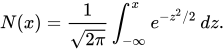
remark .

will denote the standard normal probability density office,

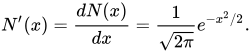
Black–Scholes equation [edit]
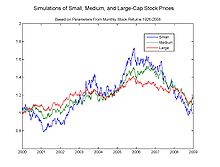
Simulated geometric Brownian motions with parameters from market information
The Black–Scholes equation is a fractional differential equation, which describes the toll of the option over fourth dimension. The equation is:

The key financial insight behind the equation is that one can perfectly hedge the option by ownership and selling the underlying asset and the bank business relationship asset (cash) in just the correct way and consequently "eliminate run a risk".[ citation needed ] This hedge, in plow, implies that there is only one correct toll for the option, as returned by the Black–Scholes formula (run across the next section).
Blackness–Scholes formula [edit]

A European call valued using the Black–Scholes pricing equation for varying asset toll and fourth dimension-to-expiry . In this detail example, the strike cost is set to one.
The Black–Scholes formula calculates the cost of European put and call options. This price is consistent with the Blackness–Scholes equation every bit higher up; this follows since the formula can be obtained by solving the equation for the corresponding terminal and boundary conditions:
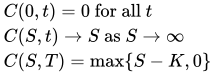
The value of a call option for a non-dividend-paying underlying stock in terms of the Black–Scholes parameters is:
![{\displaystyle {\begin{aligned}C(S_{t},t)&=N(d_{1})S_{t}-N(d_{2})Ke^{-r(T-t)}\\d_{1}&={\frac {1}{\sigma {\sqrt {T-t}}}}\left[\ln \left({\frac {S_{t}}{K}}\right)+\left(r+{\frac {\sigma ^{2}}{2}}\right)(T-t)\right]\\d_{2}&=d_{1}-\sigma {\sqrt {T-t}}\\\end{aligned}}}](https://wikimedia.org/api/rest_v1/media/math/render/svg/02b3399c25f96bc2ce3a70dbce628620cf726c29)
The price of a corresponding put option based on put–call parity with discount cistron is:


Alternative formulation [edit]
Introducing some auxiliary variables allows the formula to be simplified and reformulated in a course that is often more than convenient (this is a special instance of the Black '76 formula):
![{\displaystyle {\begin{aligned}C(F,\tau )&=D\left[N(d_{+})F-N(d_{-})K\right]\\d_{+}&={\frac {1}{\sigma {\sqrt {\tau }}}}\left[\ln \left({\frac {F}{K}}\right)+{\frac {1}{2}}\sigma ^{2}\tau \right]\\d_{-}&=d_{+}-\sigma {\sqrt {\tau }}\end{aligned}}}](https://wikimedia.org/api/rest_v1/media/math/render/svg/6dcf03e67f4b08eac9c4934f8c58d2eb8da9b3b8)
The auxiliary variables are:
with d + = d 1 and d − = d two to clarify annotation.
Given put–phone call parity, which is expressed in these terms as:

the cost of a put option is:
![P(F,\tau )=D\left[N(-d_{-})K-N(-d_{+})F\right]](https://wikimedia.org/api/rest_v1/media/math/render/svg/6816f82226a8192871a931e55a7aec6eb33bc6a7)
Interpretation [edit]
The Black–Scholes formula can be interpreted adequately handily, with the principal subtlety the interpretation of the (and a fortiori ) terms, particularly and why there are 2 different terms.[14]


The formula tin be interpreted past outset decomposing a call option into the difference of two binary options: an asset-or-zip call minus a cash-or-nothing call (long an nugget-or-nothing call, short a cash-or-nothing call). A phone call option exchanges cash for an nugget at expiry, while an asset-or-nothing call merely yields the asset (with no cash in exchange) and a cash-or-nothing call just yields greenbacks (with no nugget in exchange). The Black–Scholes formula is a difference of two terms, and these two terms equal the values of the binary call options. These binary options are much less often traded than vanilla call options, but are easier to clarify.
Thus the formula:
![C=D\left[N(d_{+})F-N(d_{-})K\right]](https://wikimedia.org/api/rest_v1/media/math/render/svg/0a5fcea5ecd192d401b49fcfb1bb4264fdd08b48)
breaks up as:

where is the nowadays value of an asset-or-nothing call and is the nowadays value of a greenbacks-or-nothing call. The D factor is for discounting, because the expiration date is in future, and removing information technology changes present value to future value (value at decease). Thus is the future value of an asset-or-nothing call and is the future value of a cash-or-nothing call. In gamble-neutral terms, these are the expected value of the asset and the expected value of the cash in the risk-neutral measure.


The naive, and not quite correct, interpretation of these terms is that is the probability of the choice expiring in the coin , times the value of the underlying at expiry F, while is the probability of the option expiring in the coin times the value of the cash at expiry K. This is wrong, as either both binaries expire in the money or both expire out of the money (either cash is exchanged for asset or it is non), but the probabilities and are non equal. In fact, can be interpreted every bit measures of moneyness (in standard deviations) and as probabilities of expiring ITM (percent moneyness), in the corresponding numéraire, as discussed beneath. Simply put, the interpretation of the cash pick, , is right, every bit the value of the cash is independent of movements of the underlying asset, and thus tin can exist interpreted as a elementary product of "probability times value", while the is more complicated, as the probability of expiring in the money and the value of the asset at expiry are not independent.[fourteen] More precisely, the value of the asset at death is variable in terms of cash, but is constant in terms of the asset itself (a stock-still quantity of the nugget), and thus these quantities are independent if one changes numéraire to the asset rather than cash.


If one uses spot S instead of forward F, in instead of the term there is which can exist interpreted as a drift factor (in the take chances-neutral measure for appropriate numéraire). The use of d − for moneyness rather than the standardized moneyness – in other words, the reason for the gene – is due to the departure between the median and hateful of the log-normal distribution; information technology is the same factor equally in Itō'due south lemma applied to geometric Brownian move. In addition, another way to meet that the naive interpretation is incorrect is that replacing by in the formula yields a negative value for out-of-the-money call options.[fourteen] : half-dozen


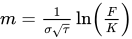
In item, the terms are the probabilities of the option expiring in-the-money nether the equivalent exponential martingale probability mensurate (numéraire=stock) and the equivalent martingale probability measure (numéraire=take chances free asset), respectively.[14] The risk neutral probability density for the stock price is
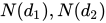

![p(S,T)={\frac {N^{\prime }[d_{2}(S_{T})]}{S_{T}\sigma {\sqrt {T}}}}](https://wikimedia.org/api/rest_v1/media/math/render/svg/9d3b51c3de2cc78a4eab52b7802d01b36eee8d37)
where is defined as above.

Specifically, is the probability that the call will exist exercised provided one assumes that the asset drift is the risk-gratuitous rate. , however, does not lend itself to a simple probability interpretation. is correctly interpreted as the present value, using the risk-gratis interest rate, of the expected asset cost at expiration, given that the asset price at expiration is above the do cost.[15] For related word – and graphical representation – run into Datar–Mathews method for real option valuation.


The equivalent martingale probability mensurate is also chosen the risk-neutral probability mensurate. Annotation that both of these are probabilities in a measure out theoretic sense, and neither of these is the true probability of expiring in-the-money under the real probability mensurate. To calculate the probability under the real ("physical") probability measure, additional information is required—the migrate term in the concrete measure, or equivalently, the market price of take chances.
Derivations [edit]
A standard derivation for solving the Black–Scholes PDE is given in the article Black–Scholes equation.
The Feynman–Kac formula says that the solution to this type of PDE, when discounted appropriately, is actually a martingale. Thus the option price is the expected value of the discounted payoff of the option. Computing the selection price via this expectation is the risk neutrality arroyo and can be done without knowledge of PDEs.[fourteen] Notation the expectation of the option payoff is not done nether the existent globe probability measure, but an artificial risk-neutral measure, which differs from the existent world mensurate. For the underlying logic see department "risk neutral valuation" under Rational pricing as well every bit section "Derivatives pricing: the Q earth" under Mathematical finance; for details, once again, see Hull.[sixteen] : 307–309
The Options Greeks [edit]
"The Greeks" measure the sensitivity of the value of a derivative product or a financial portfolio to changes in parameter values while holding the other parameters fixed. They are partial derivatives of the price with respect to the parameter values. Ane Greek, "gamma" (likewise as others not listed here) is a partial derivative of some other Greek, "delta" in this case.
The Greeks are important not only in the mathematical theory of finance, merely also for those actively trading. Fiscal institutions volition typically gear up (risk) limit values for each of the Greeks that their traders must not exceed. Delta is the virtually important Greek since this commonly confers the largest risk. Many traders will naught their delta at the stop of the day if they are not speculating on the direction of the marketplace and following a delta-neutral hedging approach every bit defined past Blackness–Scholes.
The Greeks for Blackness–Scholes are given in closed form below. They can be obtained past differentiation of the Black–Scholes formula.[17]
| Call | Put | ||
|---|---|---|---|
| Delta | |||
| Gamma | |||
| Vega | |||
| Theta | |||
| Rho | |||







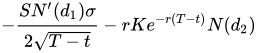




Note that from the formulae, it is articulate that the gamma is the aforementioned value for calls and puts and and then as well is the vega the same value for calls and puts options. This can be seen straight from put–telephone call parity, since the difference of a put and a call is a frontwards, which is linear in S and contained of σ (so a forrard has zero gamma and zero vega). Due north' is the standard normal probability density function.
In do, some sensitivities are usually quoted in scaled-down terms, to lucifer the calibration of likely changes in the parameters. For example, rho is often reported divided by 10,000 (1 basis point rate change), vega past 100 (one vol point alter), and theta by 365 or 252 (1 mean solar day decay based on either calendar days or trading days per yr).
Annotation that "Vega" is non a letter in the Greek alphabet; the name arises from misreading the Greek letter nu (variously rendered as , ν, and ν) as a V.

Extensions of the model [edit]
The higher up model tin can be extended for variable (but deterministic) rates and volatilities. The model may also exist used to value European options on instruments paying dividends. In this case, closed-course solutions are available if the dividend is a known proportion of the stock cost. American options and options on stocks paying a known cash dividend (in the short term, more realistic than a proportional dividend) are more than difficult to value, and a choice of solution techniques is available (for example lattices and grids).
Instruments paying continuous yield dividends [edit]
For options on indices, information technology is reasonable to brand the simplifying assumption that dividends are paid continuously, and that the dividend amount is proportional to the level of the index.
The dividend payment paid over the fourth dimension period is so modelled every bit :
![[t,t+dt]](https://wikimedia.org/api/rest_v1/media/math/render/svg/66dc1fb4c50c66c3b96beb9a0ef2bb4ab4b06c08)

for some constant (the dividend yield).

Under this conception the arbitrage-free toll implied by the Black–Scholes model can be shown to exist :
![{\displaystyle C(S_{t},t)=e^{-r(T-t)}[FN(d_{1})-KN(d_{2})]\,}](https://wikimedia.org/api/rest_v1/media/math/render/svg/e359481498ff8889f40676b5a99ab96f2176f27d)
and
![{\displaystyle P(S_{t},t)=e^{-r(T-t)}[KN(-d_{2})-FN(-d_{1})]\,}](https://wikimedia.org/api/rest_v1/media/math/render/svg/23ecf016fc6e2ff38bf8a832ba2d7903d57ff725)
where at present

is the modified frontwards price that occurs in the terms :

![{\displaystyle d_{1}={\frac {1}{\sigma {\sqrt {T-t}}}}\left[\ln \left({\frac {S_{t}}{K}}\right)+\left(r-q+{\frac {1}{2}}\sigma ^{2}\right)(T-t)\right]}](https://wikimedia.org/api/rest_v1/media/math/render/svg/f02229859886a7d520f333b84b7b8d089dc41480)
and
- .[xviii]
![{\displaystyle d_{2}=d_{1}-\sigma {\sqrt {T-t}}={\frac {1}{\sigma {\sqrt {T-t}}}}\left[\ln \left({\frac {S_{t}}{K}}\right)+\left(r-q-{\frac {1}{2}}\sigma ^{2}\right)(T-t)\right]}](https://wikimedia.org/api/rest_v1/media/math/render/svg/c710a981fc14c7d7d69423bd89b4414ed55a34df)
Instruments paying detached proportional dividends [edit]
It is as well possible to extend the Blackness–Scholes framework to options on instruments paying discrete proportional dividends. This is useful when the option is struck on a single stock.
A typical model is to assume that a proportion of the stock price is paid out at pre-adamant times . The price of the stock is then modelled every bit :



where is the number of dividends that have been paid by time .

The price of a call option on such a stock is again :
![C(S_{0},T)=e^{-rT}[FN(d_{1})-KN(d_{2})]\,](https://wikimedia.org/api/rest_v1/media/math/render/svg/c54f7f88bd1153bcb8e4c7445baf333b81c640d6)
where now

is the forward price for the dividend paying stock.
American options [edit]
The problem of finding the cost of an American selection is related to the optimal stopping trouble of finding the fourth dimension to execute the option. Since the American option tin be exercised at whatsoever time earlier the expiration date, the Black–Scholes equation becomes a variational inequality of the form
- [nineteen]

together with where denotes the payoff at stock price and the concluding status: .



In full general this inequality does not accept a airtight grade solution, though an American call with no dividends is equal to a European call and the Roll–Geske–Whaley method provides a solution for an American call with one dividend;[xx] [21] see also Blackness'due south approximation.
Barone-Adesi and Whaley[22] is a further approximation formula. Here, the stochastic differential equation (which is valid for the value of any derivative) is split up into two components: the European option value and the early on exercise premium. With some assumptions, a quadratic equation that approximates the solution for the latter is then obtained. This solution involves finding the disquisitional value, , such that one is indifferent between early on practise and holding to maturity.[23] [24]

Bjerksund and Stensland[25] provide an approximation based on an practice strategy corresponding to a trigger cost. Hither, if the underlying nugget price is greater than or equal to the trigger price information technology is optimal to practise, and the value must equal , otherwise the option "boils down to: (i) a European up-and-out telephone call pick… and (two) a rebate that is received at the knock-out date if the option is knocked out prior to the maturity engagement". The formula is readily modified for the valuation of a put option, using put–call parity. This approximation is computationally cheap and the method is fast, with evidence indicating that the approximation may be more accurate in pricing long dated options than Barone-Adesi and Whaley.[26]

Perpetual put [edit]
Despite the lack of a general belittling solution for American put options, information technology is possible to derive such a formula for the case of a perpetual option - meaning that the option never expires (i.e., ).[27] In this case, the fourth dimension decay of the pick is equal to nada, which leads to the Black–Scholes PDE becoming an ODE:


Permit denote the lower practise boundary, below which is optimal for exercising the option. The boundary conditions are:


The solutions to the ODE are a linear combination of any two linearly independent solutions:

For , substitution of this solution into the ODE for yields:


![{\displaystyle \left[{1 \over {2}}\sigma ^{2}\lambda _{i}(\lambda _{i}-1)+(r-q)\lambda _{i}-r\right]S^{\lambda _{i}}=0}](https://wikimedia.org/api/rest_v1/media/math/render/svg/2e80d9580c19d9438e55e7ed3507c4fd53fef258)
Rearranging the terms in gives:

Using the quadratic formula, the solutions for are:

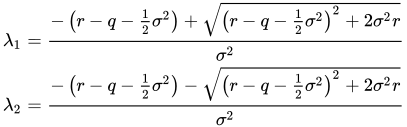
In lodge to accept a finite solution for the perpetual put, since the boundary conditions imply upper and lower finite premises on the value of the put, it is necessary to set , leading to the solution . From the first boundary condition, information technology is known that:

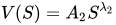

Therefore, the value of the perpetual put becomes:
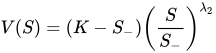
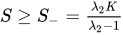
The second boundary condition yields the location of the lower practice boundary:

To conclude, for , the perpetual American put option is worth:

Binary options [edit]
By solving the Black–Scholes differential equation, with for boundary condition the Heaviside office, nosotros end up with the pricing of options that pay one unit above some predefined strike cost and nil below.[28]
In fact, the Black–Scholes formula for the cost of a vanilla call option (or put option) tin can be interpreted by decomposing a call option into an asset-or-cipher call option minus a cash-or-nothing call option, and similarly for a put – the binary options are easier to analyze, and correspond to the two terms in the Black–Scholes formula.
Cash-or-nothing call [edit]
This pays out ane unit of measurement of cash if the spot is above the strike at maturity. Its value is given by :

Greenbacks-or-nothing put [edit]
This pays out one unit of cash if the spot is below the strike at maturity. Its value is given by :

Asset-or-nothing call [edit]
This pays out ane unit of asset if the spot is to a higher place the strike at maturity. Its value is given by :

Asset-or-nothing put [edit]
This pays out one unit of nugget if the spot is below the strike at maturity. Its value is given by :

Foreign Substitution (FX) [edit]
If we announce by S the FOR/DOM exchange charge per unit (i.eastward., 1 unit of measurement of strange currency is worth S units of domestic currency) we can observe that paying out one unit of the domestic currency if the spot at maturity is higher up or beneath the strike is exactly similar a cash-or nothing phone call and put respectively. Similarly, paying out 1 unit of the foreign currency if the spot at maturity is higher up or beneath the strike is exactly like an asset-or nothing phone call and put respectively. Hence if we at present take , the strange interest rate, , the domestic interest charge per unit, and the remainder as to a higher place, we get the post-obit results.


In case of a digital call (this is a call FOR/put DOM) paying out one unit of the domestic currency nosotros get as nowadays value,

In case of a digital put (this is a put FOR/phone call DOM) paying out one unit of the domestic currency we get as nowadays value,

While in case of a digital telephone call (this is a phone call FOR/put DOM) paying out one unit of the foreign currency we go every bit present value,

and in case of a digital put (this is a put FOR/call DOM) paying out ane unit of the foreign currency we get as nowadays value,

Skew [edit]
In the standard Black–Scholes model, one can interpret the premium of the binary option in the hazard-neutral globe every bit the expected value = probability of being in-the-money * unit, discounted to the present value. The Black–Scholes model relies on symmetry of distribution and ignores the skewness of the distribution of the asset. Market place makers conform for such skewness by, instead of using a single standard deviation for the underlying nugget across all strikes, incorporating a variable one where volatility depends on strike cost, thus incorporating the volatility skew into account. The skew matters considering it affects the binary considerably more the regular options.

A binary call option is, at long expirations, similar to a tight call spread using 2 vanilla options. I can model the value of a binary greenbacks-or-aught option, C, at strike G, as an infinitesimally tight spread, where is a vanilla European telephone call:[29] [thirty]

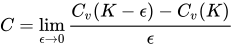
Thus, the value of a binary call is the negative of the derivative of the price of a vanilla call with respect to strike price:

When one takes volatility skew into account, is a function of :

The first term is equal to the premium of the binary choice ignoring skew:

is the Vega of the vanilla phone call; is sometimes chosen the "skew slope" or merely "skew". If the skew is typically negative, the value of a binary telephone call volition exist higher when taking skew into business relationship.



Relationship to vanilla options' Greeks [edit]
Since a binary phone call is a mathematical derivative of a vanilla call with respect to strike, the price of a binary telephone call has the same shape as the delta of a vanilla call, and the delta of a binary call has the aforementioned shape equally the gamma of a vanilla phone call.
Black–Scholes in exercise [edit]

The normality assumption of the Black–Scholes model does not capture extreme movements such as stock market crashes.
The assumptions of the Black–Scholes model are non all empirically valid. The model is widely employed as a useful approximation to reality, but proper application requires understanding its limitations – blindly following the model exposes the user to unexpected adventure.[31] [ unreliable source? ] Among the most significant limitations are:
- the underestimation of extreme moves, yielding tail run a risk, which tin be hedged with out-of-the-money options;
- the assumption of instant, price-less trading, yielding liquidity risk, which is difficult to hedge;
- the assumption of a stationary process, yielding volatility risk, which can be hedged with volatility hedging;
- the supposition of continuous time and continuous trading, yielding gap risk, which tin exist hedged with Gamma hedging.
In short, while in the Blackness–Scholes model one can perfectly hedge options by just Delta hedging, in exercise at that place are many other sources of risk.
Results using the Blackness–Scholes model differ from real world prices because of simplifying assumptions of the model. One significant limitation is that in reality security prices do non follow a strict stationary log-normal process, nor is the risk-free interest really known (and is not constant over fourth dimension). The variance has been observed to exist not-abiding leading to models such as GARCH to model volatility changes. Pricing discrepancies between empirical and the Black–Scholes model have long been observed in options that are far out-of-the-money, respective to extreme toll changes; such events would be very rare if returns were lognormally distributed, but are observed much more often in practice.
Still, Black–Scholes pricing is widely used in practice,[2] : 751 [32] because it is:
- easy to calculate
- a useful approximation, particularly when analyzing the direction in which prices move when crossing disquisitional points
- a robust basis for more refined models
- reversible, every bit the model'southward original output, toll, tin can be used as an input and one of the other variables solved for; the implied volatility calculated in this fashion is ofttimes used to quote selection prices (that is, as a quoting convention).
The first point is self-evidently useful. The others tin can be farther discussed:
Useful approximation: although volatility is not abiding, results from the model are oftentimes helpful in setting up hedges in the correct proportions to minimize risk. Even when the results are non completely accurate, they serve as a outset approximation to which adjustments can be made.
Basis for more refined models: The Black–Scholes model is robust in that information technology can be adjusted to deal with some of its failures. Rather than considering some parameters (such as volatility or interest rates) equally constant, one considers them as variables, and thus added sources of chance. This is reflected in the Greeks (the change in selection value for a change in these parameters, or equivalently the partial derivatives with respect to these variables), and hedging these Greeks mitigates the risk caused by the non-abiding nature of these parameters. Other defects cannot be mitigated past modifying the model, notwithstanding, notably tail run a risk and liquidity risk, and these are instead managed outside the model, chiefly by minimizing these risks and by stress testing.
Explicit modeling: this characteristic means that, rather than assuming a volatility a priori and computing prices from it, one tin can use the model to solve for volatility, which gives the implied volatility of an choice at given prices, durations and exercise prices. Solving for volatility over a given set up of durations and strike prices, one tin construct an implied volatility surface. In this application of the Blackness–Scholes model, a coordinate transformation from the cost domain to the volatility domain is obtained. Rather than quoting option prices in terms of dollars per unit (which are hard to compare across strikes, durations and coupon frequencies), option prices tin thus be quoted in terms of unsaid volatility, which leads to trading of volatility in pick markets.
The volatility smile [edit]
One of the attractive features of the Black–Scholes model is that the parameters in the model other than the volatility (the time to maturity, the strike, the run a risk-free interest rate, and the current underlying toll) are unequivocally observable. All other things being equal, an option'south theoretical value is a monotonic increasing office of implied volatility.
By computing the implied volatility for traded options with dissimilar strikes and maturities, the Black–Scholes model can be tested. If the Black–Scholes model held, then the implied volatility for a particular stock would exist the same for all strikes and maturities. In practice, the volatility surface (the 3D graph of implied volatility against strike and maturity) is non apartment.
The typical shape of the implied volatility bend for a given maturity depends on the underlying instrument. Equities tend to have skewed curves: compared to at-the-money, unsaid volatility is essentially higher for depression strikes, and slightly lower for high strikes. Currencies tend to have more symmetrical curves, with implied volatility everyman at-the-money, and higher volatilities in both wings. Commodities often have the opposite beliefs to equities, with higher implied volatility for higher strikes.
Despite the being of the volatility smiling (and the violation of all the other assumptions of the Black–Scholes model), the Black–Scholes PDE and Blackness–Scholes formula are still used extensively in practice. A typical approach is to regard the volatility surface every bit a fact about the market, and use an implied volatility from it in a Black–Scholes valuation model. This has been described as using "the wrong number in the wrong formula to get the right price".[33] This approach as well gives usable values for the hedge ratios (the Greeks). Even when more advanced models are used, traders adopt to retrieve in terms of Black–Scholes implied volatility as information technology allows them to evaluate and compare options of different maturities, strikes, and then on. For a discussion as to the diverse alternative approaches developed here, meet Financial economics § Challenges and criticism.
Valuing bail options [edit]
Black–Scholes cannot be applied direct to bond securities because of pull-to-par. As the bond reaches its maturity date, all of the prices involved with the bond become known, thereby decreasing its volatility, and the simple Black–Scholes model does non reflect this process. A large number of extensions to Black–Scholes, beginning with the Blackness model, have been used to deal with this miracle.[34] Meet Bond option § Valuation.
Involvement - charge per unit curve [edit]
In practice, interest rates are not abiding – they vary past tenor (coupon frequency), giving an involvement rate bend which may be interpolated to pick an advisable rate to use in the Blackness–Scholes formula. Some other consideration is that interest rates vary over time. This volatility may make a meaning contribution to the price, especially of long-dated options. This is but like the interest charge per unit and bond cost relationship which is inversely related.
Brusk stock rate [edit]
Taking a curt stock position, as inherent in the derivation, is not typically gratis of cost; equivalently, it is possible to lend out a long stock position for a small fee. In either instance, this tin can be treated as a continuous dividend for the purposes of a Black–Scholes valuation, provided that in that location is no glaring asymmetry betwixt the short stock borrowing cost and the long stock lending income.[ citation needed ]
Criticism and comments [edit]
Espen Gaarder Haug and Nassim Nicholas Taleb argue that the Black–Scholes model only recasts existing widely used models in terms of practically impossible "dynamic hedging" rather than "risk", to brand them more than compatible with mainstream neoclassical economic theory.[35] They also assert that Boness in 1964 had already published a formula that is "actually identical" to the Black–Scholes call pick pricing equation.[36] Edward Thorp also claims to take guessed the Black–Scholes formula in 1967 but kept information technology to himself to brand money for his investors.[37] Emanuel Derman and Nassim Taleb have likewise criticized dynamic hedging and state that a number of researchers had put forth like models prior to Black and Scholes.[38] In response, Paul Wilmott has defended the model.[32] [39]
In his 2008 letter to the shareholders of Berkshire Hathaway, Warren Buffett wrote: "I believe the Black–Scholes formula, fifty-fifty though it is the standard for establishing the dollar liability for options, produces strange results when the long-term diverseness are existence valued... The Blackness–Scholes formula has approached the status of holy writ in finance ... If the formula is practical to extended time periods, however, information technology can produce cool results. In fairness, Black and Scholes almost certainly understood this indicate well. Just their devoted followers may be ignoring whatever caveats the two men fastened when they get-go unveiled the formula."[40]
British mathematician Ian Stewart, author of the 2012 book entitled In Pursuit of the Unknown: 17 Equations That Changed the World,[41] [42] said that Black–Scholes had "underpinned massive economic growth" and the "international financial arrangement was trading derivatives valued at one quadrillion dollars per yr" by 2007. He said that the Blackness–Scholes equation was the "mathematical justification for the trading"—and therefore—"one ingredient in a rich stew of financial irresponsibility, political ineptitude, perverse incentives and lax regulation" that contributed to the financial crunch of 2007–08.[43] He clarified that "the equation itself wasn't the real problem", simply its abuse in the financial industry.[43]
See besides [edit]
- Binomial options model, a detached numerical method for computing pick prices
- Black model, a variant of the Black–Scholes choice pricing model
- Blackness Shoals, a fiscal fine art slice
- Brownian model of financial markets
- Fiscal mathematics (contains a listing of related manufactures)
- Fuzzy pay-off method for real choice valuation
- Estrus equation, to which the Black–Scholes PDE tin can be transformed
- Jump diffusion
- Monte Carlo option model, using simulation in the valuation of options with complicated features
- Real options analysis
- Stochastic volatility
Notes [edit]
- ^ Although the original model assumed no dividends, petty extensions to the model tin accommodate a continuous dividend yield cistron.
References [edit]
- ^ "Scholes on merriam-webster.com". Retrieved March 26, 2012.
- ^ a b Bodie, Zvi; Alex Kane; Alan J. Marcus (2008). Investments (7th ed.). New York: McGraw-Hill/Irwin. ISBN978-0-07-326967-two.
- ^ Taleb, 1997. pp. 91 and 110–111.
- ^ Mandelbrot & Hudson, 2006. pp. nine–x.
- ^ Mandelbrot & Hudson, 2006. p. 74
- ^ Mandelbrot & Hudson, 2006. pp. 72–75.
- ^ Derman, 2004. pp. 143–147.
- ^ Thorp, 2017. pp. 183–189.
- ^ MacKenzie, Donald (2006). An Engine, Not a Photographic camera: How Financial Models Shape Markets. Cambridge, MA: MIT Press. ISBN0-262-13460-viii.
- ^ "The Sveriges Riksbank Prize in Economic Sciences in Memory of Alfred Nobel 1997".
- ^ "Nobel Prize Foundation, 1997" (Press release). Oct fourteen, 1997. Retrieved March 26, 2012.
- ^ Black, Fischer; Scholes, Myron (1973). "The Pricing of Options and Corporate Liabilities". Periodical of Political Economy. 81 (3): 637–654. doi:10.1086/260062. S2CID 154552078.
- ^ Merton, Robert (1973). "Theory of Rational Option Pricing". Bell Journal of Economic science and Management Science. iv (ane): 141–183. doi:10.2307/3003143. hdl:10338.dmlcz/135817. JSTOR 3003143.
- ^ a b c d due east Nielsen, Lars Tyge (1993). "Understanding N(d 1) and Due north(d 2): Adventure-Adjusted Probabilities in the Black–Scholes Model" (PDF). Revue Finance (Journal of the French Finance Clan). xiv (1): 95–106. Retrieved Dec 8, 2012, before circulated as INSEAD Working Paper 92/71/FIN (1992); abstract and link to commodity, published commodity. CS1 maint: postscript (link)
- ^ Don Chance (June 3, 2011). "Derivation and Estimation of the Blackness–Scholes Model" (PDF) . Retrieved March 27, 2012.
- ^ Hull, John C. (2008). Options, Futures and Other Derivatives (7th ed.). Prentice Hall. ISBN978-0-13-505283-ix.
- ^ Although with pregnant algebra; see, for instance, Hong-Yi Chen, Cheng-Few Lee and Weikang Shih (2010). Derivations and Applications of Greek Letters: Review and Integration, Handbook of Quantitative Finance and Take a chance Management, III:491–503.
- ^ "Extending the Black Scholes formula". finance.bi.no. Oct 22, 2003. Retrieved July 21, 2017.
- ^ André Jaun. "The Black–Scholes equation for American options". Retrieved May 5, 2012.
- ^ Bernt Ødegaard (2003). "Extending the Black Scholes formula". Retrieved May v, 2012.
- ^ Don Chance (2008). "Closed-Form American Call Option Pricing: Roll-Geske-Whaley" (PDF) . Retrieved May xvi, 2012.
- ^ Giovanni Barone-Adesi & Robert E Whaley (June 1987). "Efficient analytic approximation of American pick values". Periodical of Finance. 42 (two): 301–20. doi:x.2307/2328254. JSTOR 2328254.
- ^ Bernt Ødegaard (2003). "A quadratic approximation to American prices due to Barone-Adesi and Whaley". Retrieved June 25, 2012.
- ^ Don Chance (2008). "Approximation Of American Option Values: Barone-Adesi-Whaley" (PDF) . Retrieved June 25, 2012.
- ^ Petter Bjerksund and Gunnar Stensland, 2002. Airtight Form Valuation of American Options
- ^ American options
- ^ Crack, Timothy Falcon (2015). Heard on the Street: Quantitative Questions from Wall Street Task Interviews (16th ed.). Timothy Fissure. pp. 159–162. ISBN9780994118257.
- ^ Hull, John C. (2005). Options, Futures and Other Derivatives. Prentice Hall. ISBN0-13-149908-4.
- ^ Breeden, D. T., & Litzenberger, R. H. (1978). Prices of state-contingent claims implicit in option prices. Periodical of business, 621-651.
- ^ Gatheral, J. (2006). The volatility surface: a practitioner's guide (Vol. 357). John Wiley & Sons.
- ^ Yalincak, Hakan (2012). "Criticism of the Blackness–Scholes Model: But Why Is It Still Used? (The Respond is Simpler than the Formula". SSRN 2115141.
- ^ a b Paul Wilmott (2008): In defence of Black Scholes and Merton Archived 2008-07-24 at the Wayback Machine, Dynamic hedging and further defense of Black–Scholes [ permanent expressionless link ]
- ^ Riccardo Rebonato (1999). Volatility and correlation in the pricing of equity, FX and involvement-rate options. Wiley. ISBN0-471-89998-4.
- ^ Kalotay, Andrew (November 1995). "The Problem with Black, Scholes et al" (PDF). Derivatives Strategy.
- ^ Espen Gaarder Haug and Nassim Nicholas Taleb (2011). Choice Traders Apply (very) Sophisticated Heuristics, Never the Black–Scholes–Merton Formula. Periodical of Economic Behavior and Organization, Vol. 77, No. 2, 2011
- ^ Boness, A James, 1964, Elements of a theory of stock-option value, Journal of Political Economy, 72, 163–175.
- ^ A Perspective on Quantitative Finance: Models for Chirapsia the Market, Quantitative Finance Review, 2003. Also see Choice Theory Part 1 past Edward Thorpe
- ^ Emanuel Derman and Nassim Taleb (2005). The illusions of dynamic replication Archived 2008-07-03 at the Wayback Auto, Quantitative Finance, Vol. 5, No. 4, August 2005, 323–326
- ^ See also: Doriana Ruffinno and Jonathan Treussard (2006). Derman and Taleb'southward The Illusions of Dynamic Replication: A Comment, WP2006-019, Boston University - Section of Economics.
- ^ [ane]
- ^ In Pursuit of the Unknown: 17 Equations That Changed the World. New York: Basic Books. 13 March 2012. ISBN978-one-84668-531-6.
- ^ Nahin, Paul J. (2012). "In Pursuit of the Unknown: 17 Equations That Inverse the World". Physics Today. Review. 65 (9): 52–53. Bibcode:2012PhT....65i..52N. doi:x.1063/PT.3.1720. ISSN 0031-9228.
- ^ a b Stewart, Ian (Feb 12, 2012). "The mathematical equation that caused the banks to crash". The Guardian. The Observer. ISSN 0029-7712. Retrieved April 29, 2020.
Primary references [edit]
- Blackness, Fischer; Myron Scholes (1973). "The Pricing of Options and Corporate Liabilities". Journal of Political Economic system. 81 (3): 637–654. doi:10.1086/260062. S2CID 154552078. [2] (Black and Scholes' original paper.)
- Merton, Robert C. (1973). "Theory of Rational Option Pricing". Bong Periodical of Economics and Management Scientific discipline. The RAND Corporation. four (1): 141–183. doi:10.2307/3003143. hdl:10338.dmlcz/135817. JSTOR 3003143. [3]
- Hull, John C. (1997). Options, Futures, and Other Derivatives. Prentice Hall. ISBN0-13-601589-1.
Historical and sociological aspects [edit]
- Bernstein, Peter (1992). Capital Ideas: The Improbable Origins of Modern Wall Street. The Free Press. ISBN0-02-903012-9.
- Derman, Emanuel. "My Life as a Quant" John Wiley & Sons, Inc. 2004. ISBN 0471394203
- MacKenzie, Donald (2003). "An Equation and its Worlds: Bricolage, Exemplars, Disunity and Performativity in Fiscal Economic science" (PDF). Social Studies of Science. 33 (half dozen): 831–868. doi:10.1177/0306312703336002. hdl:xx.500.11820/835ab5da-2504-4152-ae5b-139da39595b8. S2CID 15524084. [4]
- MacKenzie, Donald; Yuval Millo (2003). "Constructing a Marketplace, Performing Theory: The Historical Sociology of a Financial Derivatives Substitution". American Journal of Sociology. 109 (1): 107–145. CiteSeerX10.1.i.461.4099. doi:ten.1086/374404. S2CID 145805302. [five]
- MacKenzie, Donald (2006). An Engine, not a Camera: How Fiscal Models Shape Markets. MIT Printing. ISBN0-262-13460-8.
- Mandelbrot & Hudson, "The (Mis)Beliefs of Markets" Bones Books, 2006. ISBN 9780465043552
- Szpiro, George G., Pricing the Time to come: Finance, Physics, and the 300-Year Journey to the Blackness–Scholes Equation; A Story of Genius and Discovery (New York: Basic, 2011) 298 pp.
- Taleb, Nassim. "Dynamic Hedging" John Wiley & Sons, Inc. 1997. ISBN 0471152803
- Thorp, Ed. "A Human for all Markets" Random Firm, 2017. ISBN 9781400067961
Further reading [edit]
- Haug, E. Yard (2007). "Option Pricing and Hedging from Theory to Exercise". Derivatives: Models on Models. Wiley. ISBN978-0-470-01322-ix. The book gives a series of historical references supporting the theory that option traders use much more than robust hedging and pricing principles than the Black, Scholes and Merton model.
- Triana, Pablo (2009). Lecturing Birds on Flight: Can Mathematical Theories Destroy the Financial Markets?. Wiley. ISBN978-0-470-40675-5. The book takes a critical look at the Blackness, Scholes and Merton model.
External links [edit]
Discussion of the model [edit]
- Ajay Shah. Black, Merton and Scholes: Their work and its consequences. Economic and Political Weekly, XXXII(52):3337–3342, December 1997
- The mathematical equation that caused the banks to crash by Ian Stewart in The Observer, February 12, 2012
- When You Cannot Hedge Continuously: The Corrections to Black–Scholes, Emanuel Derman
- The Skinny On Options TastyTrade Show (archives)
Derivation and solution [edit]
- Derivation of the Black–Scholes Equation for Choice Value, Prof. Thayer Watkins
- Solution of the Black–Scholes Equation Using the Dark-green'south Function, Prof. Dennis Silverman
- Solution via gamble neutral pricing or via the PDE approach using Fourier transforms (includes discussion of other option types), Simon Leger
- Step-past-step solution of the Black–Scholes PDE, planetmath.org.
- The Black–Scholes Equation Expository commodity by mathematician Terence Tao.
Computer implementations [edit]
- Black–Scholes in Multiple Languages
- Black–Scholes in Java -moving to link below-
- Black–Scholes in Coffee
- Chicago Option Pricing Model (Graphing Version)
- Blackness–Scholes–Merton Implied Volatility Surface Model (Java)
- Online Blackness–Scholes Calculator
Historical [edit]
- Trillion Dollar Bet—Companion Web site to a Nova episode originally broadcast on February 8, 2000. "The film tells the fascinating story of the invention of the Black–Scholes Formula, a mathematical Holy Grail that forever contradistinct the world of finance and earned its creators the 1997 Nobel Prize in Economics."
- BBC Horizon A TV-program on the so-chosen Midas formula and the bankruptcy of Long-Term Uppercase Management (LTCM)
- BBC News Magazine Black–Scholes: The maths formula linked to the financial crash (Apr 27, 2012 article)

Source: https://en.wikipedia.org/wiki/Black%E2%80%93Scholes_model
Posted by: kincerwhatinfore.blogspot.com
0 Response to "black scholes formula for binary option"
Post a Comment